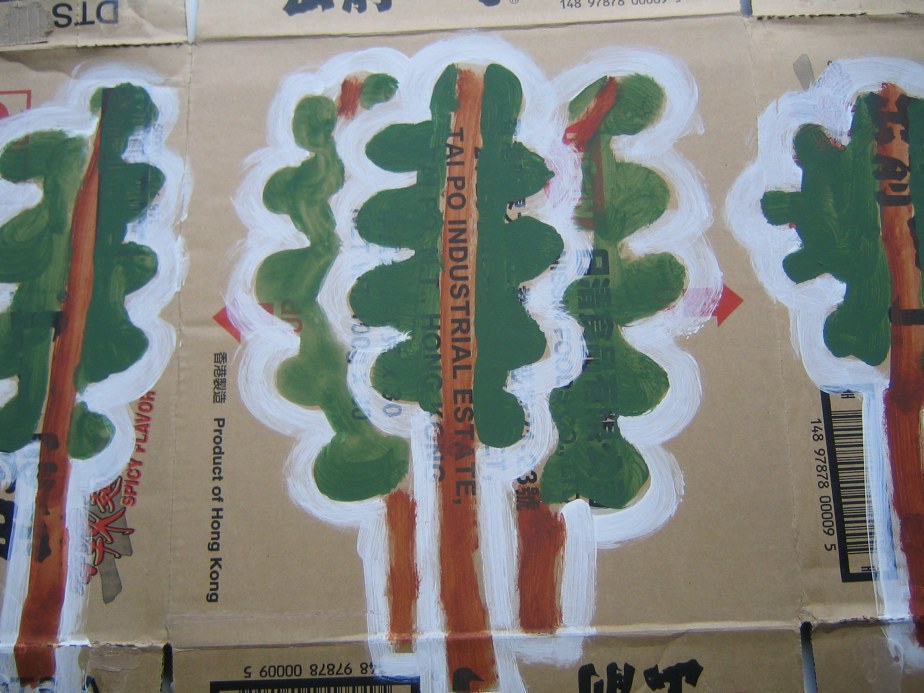
acrylic on cardboard
Art – Writing

acrylic on cardboard
Imagine you live under the stars in Central Australia. Your family has lived there for thousands of years. You know the names of every geological feature, animal and plant that surrounds you and how they were made. You are related to everything and everyone. The pathways that the creator ancestors and your family travel upon are one and the same. Then someone comes along with their animals, their laws and their religion, claims the land for themselves, and you are marginalised, an exile in your own land.
The shocking experience of deracination suffered by Central Australian Aboriginal people did not mean the end of their culture though who knew that it would eventually open a new chapter in Australian art. Is it a new chapter though or the re-opening of a very old one?
Three years in the making Tjukurrtjanu: Origins of Western Desert Art curated by Judith Ryan, Senior Curator at the NGV, and Philip Batty, Senior Curator at the Museum of Victoria, is the newest exhibition to examine the astonishing phenomena that is Western Desert painting.
This is perhaps the most studied art movement in Australia. It continues to create waves and surprises both in Central Australia and in places far away from it. Tjukurrtjanu is a coming together of art gallery and museum approaches to exhibiting, white walls and corroborating artefacts from the past, minimal labels and ethnographic documents. In these ways it exemplifies the debates, the balancing acts, between ethnography and aesthetics that has characterised the reception of this art over the years.
It is easy to rave about the exhibition, about the beauty, delicacy and power of the 200 paintings made in 1971 and 1972 by twenty of the thirty-five original Papunya Tula artists on show. As you walk around, and one visit is certainly not enough to truly look at even half the show, you are very conscious that the paintings are not on canvas but are on boards, hard sometimes irregular-shaped surfaces, and you get a clear sense of them as diagrams, maps, demonstrations, teaching aids, signs of magic and manifestations of ancestral power. In some cases their clear instructive role is further emphasised as they literally resemble blackboards with paintings on them, optically mesmerising blackboards that pulse and vibrate, their veiled depths drawing you in to speculate about their meanings which are not necessarily available to you but very clear in their intensity.
Yet there seems some uneasy ambivalence in this show towards its audience. As an art historical and museological exercise urgently asserting the ancient continuity of the art more than its currency as an art experience, the exhibition is sometimes in danger of wearing out its audience, of being too didactic, of not letting the work be. The short film of a fire ceremony and the slides of decorated dancers throw the viewer into the position of an anthropologist. The excerpts of unpublished film footage by Geoff Bardon on the other hand call up the place called Papunya, the Honey Ant Dreaming hills reflected in the pools of heavy rain that fell at the time, the faded Kodachrome yellows and blues evoking the potential poetry of everyone’s mystic and mythic past.
There is no question that you need to pour over the catalogue. Then go and read Lives of the Papunya Tula Artists by Vivien Johnson; and Geoffrey Bardon’s Papunya: A place made after the story, the beginnings of the Western Desert Painting Movement.
Then imagine the stars in Central Australia.
Stephanie Radok
National Gallery of Victoria, Federation Square, 30 September 2011 – 12 February 2012. Tjukurrtjanu travelled to Paris and was shown at the musée du quai Branly from 9 October 2012 to 27 January 2013.
First published in The Melbourne Review, Dec 2011- Jan 2012.
Do we look at photographs in a different way from other artforms? Or to put the question another way are there things that photography does that are special to it as a medium?
One feature of photography in spite of all the photo-shopping, set-ups and fakery that we know are possible is that it often has a relationship to reality that sets it in time and place with a truth factor that has a strong appeal. It means that photographs include details that the photographer didn’t control, that show us slices of life with a certain familiarity so that we recognise and trust that the understandings we receive from them have a basis in fact. Photographs are witnesses, records, proofs.
It is said that people who have never seen photographs take a while to see them as more than flat marks on paper suggesting photography is culturally specific but what about the experience of the camera obscura in which a simple hole projects the world in fine grained detail though admittedly upside down? Humans may have invented cameras but the process that cameras use is embedded in the world, in the mechanics of the eye and the nature of light. That is why we recognise the truth of photographs, we don’t invent them, we take them.
Many photographs achieve an iconic status almost from when we first see them. In the two important national touring exhibitions of photographs Robert McFarlane: Received Moments at the Flinders University City Gallery and Ricky Maynard: Portrait of a Distant Land at Tandanya there are many photographs which have become icons for example McFarlane’s image of Aboriginal activist Charles Perkins on his way to Sydney University. The fact that the 1965 Freedom Ride through western New South Wales with which Perkins is associated involved travel on a bus is somehow present in this image of a thoughtful man who fought discrimination and made history.
Adelaide-born McFarlane was also one of the photographers taking images for the 1988 publication After 200 years: photographic essays of Aboriginal and Islander Australia today. The engrossing image Cherbourg Wedding from this book shows three generations of an Aboriginal family watched over by a framed photograph of Winston Churchill. Time capsule seems a good word for McFarlane’s exhibition in general where many images show an Australia that is now gone in small black and white images that evoke newspapers and newsreels. By “received moments” McFarlane, also a well-known writer on photography, refers to a kind of gift or grace that the photographer looks out for and then if he or she is ready with camera in hand can harvest.
Tasmanian-born descendant of the Big River and Ben Lomond people Ricky Maynard was also a photographer for the After 200 years project in 1988. All of Maynard’s photographic project is deliberately a recording of indigenous life and history. He sees photography as necessarily collaboration. In his words: “Standard photographic technique is essentially an act of subjugation, in which people are invariably reduced to objects for the use of the photographer… To build an alternative practice, a convivial photography, we need to abolish this oppressive relationship. Co-authorship must be established beforehand. It is impossible to fight oppression by reproducing it.”
Maynard’s portraits show us direct gazes and long histories in the faces of people into whose eyes we may not have looked so deeply before. They ask us to empathise, to reflect and to recognise a common humanity. Portrait of a Distant Land features more than 60 photographs drawn from six iconic bodies of work – The Moonbird People (1985-88), No More Than What You See (1993), Urban Diary (1997), In The Footsteps of Others (2003), Returning To Places That Name Us (2000) and Portrait of a Distant Land (2005- ).
Maynard often uses oral history in extended titles. The accompanying words for The Healing Garden, Wybalenna, Flinders Island, Tasmania 2005 are from Aunty Ida West in 1995: “It’s pretty important you know, the land, it doesn’t matter how small, it’s something, just a little sacred site, that’s Wybalenna. There was a massacre there, sad things there, but we try not to go over that. Where the bad was we can always make it good.”
When we look at the photograph The Healing Garden and see these trees surrounded by a low fence we can imagine the feeling of sanctuary they contain as well as the sound of the wind in them and the scent of their shade. We know we don’t know what happened there but we sense a presence as in a cemetery. Maynard says: “These pictures will live on in history, showing the moment to itself, showing what needs to be changed and hoping some day we can look back and see how far we have progressed as a society.”
Stephanie Radok
Robert McFarlane: received moments: Photography 1961-2009
Flinders University City Gallery
29 October – 1 December 2011
South of my days’ circle, part of my blood’s country…
I know it dark against the stars, the high lean country
full of old stories that still go walking in my sleep.
Judith Wright (1915 – 2000)
While strongly connecting to the Southern Hemisphere the idea of South goes beyond geography and includes all who seek to extend the intellectual, social and geographic boundaries of contemporary art through dialogue, collaboration and exchange.
The first time I remember thinking about South as an encompassing term was when I read the 1980 Brandt Report by the Independent Commission on International Development Issues, the report was also called North South: A Program for Survival. In the report South is synonymous with poverty. The Commission advocated a large scale transfer of resources from the wealthy North to the South and a restructuring of the global economy.
The film Bamako (2006) by Abderrahmane Sissako (France/Mali) shown at the 2007 Adelaide Film Festival took up these issues in an allegory in which the North in the form of the IMF and the World Bank is on trial by the South. Bamako is the capital of Mali, one of the poorest countries in the world. The film counterposes the courtroom with daily life. Both take place in the open-air courtyard of a house, a place also used for eating, washing and dying great skeins of cloth. The bringing together of daily life and work with the court has the effect of both humanising and humorising the message of the film and the serious issues of inhumanity it addresses.
My subsequent early thinking about South was connected to Bernard Smith’s great book European Vision and the South Pacific and its descriptions of cultural dialogues between north and south, old worlds and new worlds. In preparing the South Issue of Artlink I interviewed the ninety-year old Smith in Melbourne and found out how he came to write the book, the title of which I like so much because, in my interpretation anyway, vision means both what we see and what we dream. Over a cup of tea and a Spanish biscuit the spry Smith pronounced, in reference to the names of the influential art publishers Thames & Hudson, that there are other rivers in the world, and that we are all the other.
The South Project, initially devised as an alternative to a Melbourne International Biennale, has been managed by Craft Victoria as a four year journey; it organizes forums, residencies, exhibitions and acts as a catalyst for bringing people together. One recurrent feature of the South Project is paying attention to Indigenous peoples’ cultures, their ideas and ways of being. One of the incentives for me to attend the first South Project Forum in Melbourne in 2004 was because there were people attending from one of the strangest and most faraway places in the world Rapa Nui (Easter Island), and speaking in their own language! The question of translation is another recurring feature of the South Project, not simply translation to understand what someone is saying but to multiply ideas and to widen the potential range of possible meanings. That first forum was followed by the 2005 South Project Forum in Wellington, Aotearoa New Zealand. In 2006 I went to Santiago in Chile for the third South Project Forum; the fourth is to be in October 2007 in Johannesburg, South Africa.
Many of the people I met or heard about in Santiago are present in this Artlink in articles and images. Some were not able to be included. Like artist Francisco Brugnoli the lively director of the Museo Art Contemporaneo in Santiago, a building he brought back from ruin to the magnificent contemporary art museum it is today. He spoke eloquently about being in exile at home. Then there was artist Jesus Macarena, a co-founder in 1996 of POLVO an artist-run space in Chicago working with the Immigrant Rights Movement. While the South Forum was on in Santiago new legislation came through in Paraguay protecting the cultural rights of indigenous people there. Ticio Escobar who has been working with those people for thirty years spoke about the Museo del Barro (Museum of Mud) which includes Indigenous art, contemporary art and popular art. He spoke about culture as a tool for survival for each of us.
And then there were those people I never met but have found on the internet like Australian filmmaker Tiger Brown in New York who sent me his DVD Los Chamacocos Bravos, a film about Paraguayan Indigenous people that he made with Aristide Escobar, brother of Ticio. One of the most inspiring art projects that I came across and was not able to include is New York-based artist Pablo Helguera’s School of Panamerican Unrest, a 2006 public art project in which he took a large installation in the form of a schoolhouse to thirty cities from one end of America to the other, Anchorage in Alaska to Ushuiaia in Patagonia, meeting people and talking about what connects nationality and culture. He wrote:
‘Art has an enormous potential to be relevant outside the art world, but for that to happen, we need to use the tools of art to create understanding instead of simply promoting the understanding of art.’
Another significant film shown at the Adelaide Film Festival this year was Darratt (Dry Season) by Mahamat Saleh Haroun (Chad), one of Peter Sellars’ commissioned New Crowned Hope films. The complexity of revenge and of justice is brought home in the film and as with viewing Bamako it is seeing the most ordinary aspects of daily life in another country which bring home the humanity of those sometimes called the ‘others’.
While the great art markets, the fairs and the gatekeepers, the power to write history and to determine still tend to be based in the Northern Hemisphere, there are many other rivers, purposes, histories and agendas of and for art and there is success that is not measured in money.
Stephanie Radok, Editorial, THE SOUTH ISSUE: NEW HORIZONS, Artlink, June 2007.
In Jean-Paul Sartre’s novel Nausea the narrator repeatedly listens to an American jazz record – Some of these days you’ll miss me honey – and finds it an exemplar of both transience and immortality. A record is a memory. Un ricordo. It goes round and round, its crackly revolutions bringing back what has been forgotten or ghosting what is lost beyond recall. Rescued from a cellar, a shed or a vinyl dealer, a record is a survivor. Latin rhythms, folk wistfulness, the classics, 33 loops per minute for the long players, bowling the past up, full circle, the record’s surface shines, reflecting the viewer’s curiosity. Yet its fine incisions absorb the light of the present in matte black oblivion. The label splits like the moon, dark side and light.
On this unlikely surface Stephanie Radok has painted vessels, their colorful curves intersecting with the record’s grooves to suggest a different kind of remembering. The pots and jugs and vases are household objects brought with her peripatetic family on journeys between Australia and Europe and America. The vessels, like the family, are survivors. They have borne packing and transport, relocation and changing use. Yet their bright aesthetic is testimony to an ample holding capacity. Bold paintstrokes celebrate routine domesticity. Yet layered on black vinyl – the sheen of home entertainment in that lost new world of the 1950s and 1960s – the brushwork of those cherished memories becomes streaked and transparent. What we bring with us are not just things but cultures, customs, bonds. And they are newly lived, in unsettled conjunctions, according to time and place. What remains, when we look back quizzically, are intense, enigmatic, stubborn disruptions of colour and shape. Empty vessels that carry our lives in more complex ways than we knew.
The World-tree series, paintings on loose canvas made by Radok in 2002 for an exhibition called The Immigrant’s Garden, showed a magical tree that a child might draw, branching and curving up with arms outstretched. What we bring with us gives a similar sense of uplift, only now to a syncopated beat, bolder and more shadowed. The artist follows the bouncing ball that keeps getting away, spinning, turning, backwards and forwards in time, in and out of highly charged personal space.
As companion works Radok shows plaster casts of books, delicately coloured fossils. Books are another form of record, containers of cultural knowledge. Rendered in plaster they evoke the elusive and suggestive spaces of memory. What we bring with us is personal, familial, wittily including elements of playful consumption and self-invention. Is this art of losing or finding? Of reducing life to minimal necessities or amplifying it to ever more resonant forms and sensations?
Nicholas Jose
June 2006
what we bring with us: Stephanie Radok, Watson Place Gallery, Melbourne, July, 2006.
As Australians become more aware of the micro-environments in which they live as well as more integrated into a world economy and culture their concern with place falls between the extremes of absolute specificity and total placelessness. Each of us is familiar with places such the internet, airports, chain restaurants and shops, that make it possible for us to move around the world yet seem to stay in the same place, or to stay in one place and seem to move around the world.
At the same time as these non-specific places become more available to us, increased understanding of ecology, indigeneity and a self-preserving instinct for home assert the value of intimate knowledge of place built up over decades and generations if not centuries. Yet longevity in a place is not a choice available to a lot of people, whether through migration, dispossession, the diasporas brought about by the events of world history, or personal quests for prosperity, in the pursuit of careers, dreams or even love.
Environmental historian Peter Read, in his two recent books Returning to Nothing: lost places (1996) and Belonging: Australians, Place and Aboriginal Ownership (2000) seeks, in his own words, to shape an imprecise but certain knowledge. His research emphasizes in particular the historical moment at which Australia and Australians have arrived, a time for the telling, affirming and elaboration in a new way of the belonging to Australia of non-Indigenous Australians.
General knowledge of Aboriginal and Torres Strait Islander prior ownership and culture is now irrevocably widespread and entrenched both legally and conceptually in Australian history. This can be clearly seen in the stories that museums are now telling and in educational material for schools. Black armband/white blindfold – the truth surely lies somewhere in-between but it is certain that many Indigenous concepts such as ‘dreaming’, ‘country’, ‘sacred site’, ‘women’s business’ have firmly entered the Australian vernacular. This is evident even in the title of the recent volume Words for country: landscape and language in Australia (2002) edited by Tim Bonyhady and Tom Griffiths, a series of essays by different authors on specific places, many of which concern mingled Indigenous and non-Indigenous histories.
Closer understanding of Australia’s human past goes hand in hand with an awareness of its unique flora, fauna, landforms, climate and so on. Yet much of the current energy and vitality of understanding Australia right now lies in the fresh valuing and recognition of the hybridity of non-Indigenous peoples and their stories, both those originating here and those brought here from scores of other places. No cultural group has a monopoly on the notion of attachment to place. The cross-cultural links, the translations of languages and meanings that can be drawn across such common feelings are useful for acknowledging similarities between different peoples.
Could it be that a unique type of polyculture is possible in Australia, where recognition of the Indigenous need not be used to cause non-Indigenes to cringe because of their relatively recent arrival on this soil but the Indigenous can be seen as a proud predecessor and exemplar of the rich possibilities of endemic or highly adapted development to place, alongside a usefully increased awareness and taking into account of the global as well as of the local? We are certainly all indigenous to the earth.
Local understanding of climate, vernacular and geography, the beauty and depth of an intimate knowledge of a place is something that Aboriginal art expresses effortlessly. Art that is made by non-Aboriginal artists whether they are from European, Asian, Middle Eastern, South or North American backgrounds also relates to Australia as a place as well as connecting to complex global issues. Local knowledge of the land cannot be acquired quickly. It involves duration, it takes account of the seasons of the earth, the passage of the sun across the sky, the angle of light, the passing of time, cycles and rhythms both circadian and annual.
Yet place is not only about land, it is also about habitation (living) and habitations (homes), about cities and suburbs, cultures and civilizations, thoughts, ideas and philosophies, objects, scents, dreams, memories, words. The taste of a certain food may call up associations that evoke another place and another time. You can be reading a book and return to where you are sitting and know that you have been to another place.
Taking a broad view of the idea of place enables this issue of Artlink to reflect the multiplicity of places now present in Australia. Place evokes common ground rather than difference even as it marks that common ground by its valuing of the validity and significance of individual experience. Place transcends such terms as regionalism and provincialism as it emphasizes the universality of the need to belong. Connecting threads tug and pull across the work of the writers and artists. in this issue of Artlink. Many articles are linked to websites that expand the material present in the magazine. Each piece of work here alerts us to place as something both familiar and strange, as something within us as much as it is outside us.
There are about 150 different ethnic groups in Australia, there are around 8,000 world-wide. In the face of the current intermingling of cultures around the world it has been claimed that it is no longer possible to understand each other culture we may encounter and to thus base civic behaviour and rules on rationality. Rather it has been suggested that the new civic values should be tolerance, love, trust and mildness which, at this moment of ongoing world crises, is definitely worth taking to heart in order that we enter the future with a sense of possibility and awakening.
Stephanie Radok, Editorial for PLACE issue of Artlink
Talking about country: people and plants
a celebration of migration and local knowledge
The paintings on show here are made with watercolour paint made in Australia, brushes made in China and paper made in France. They are painted by a person who was born in Melbourne, then grew up in North America and Europe and Australia.
There are 256 paintings of which 85 are on show. Altogether there is a painting for every country in the world.
The plants in the paintings are not the botanic or floral emblems of the countries.
Rather each painting contains an image of a plant or a part of a plant that is found in South Australia.
The point of this contrariness at this moment in Australian history, a time of intense reflection and discussion about migration, is to make several points:
1. all countries have native plants that are loved by their people.
2. often these plants migrate in one way or another and are found in other countries than their place of origin.
3. the movement of plants around the world has some similarities with the movement of people around the world.
4. plants preceded all peoples on the earth and all names for them, and all classifications and taxonomies. In the beginning was the world, not the word. Can we imagine a time when plants and countries had no names?
5. a plant and a person from almost every country in the world can now be found in South Australia, and not only in the Botanic Gardens.
6. a lot of the plants we love are native to Australia, a lot are plants that have migrated and thrived here.
7. the indigenous plants and those who have come in successive waves of migration form the country we live in and make it the place it is now.
8. it is a place that is now aware and appreciative of the Aboriginal people and their cultures but also positive about cultures brought here over the last two hundred years. And the new ones being formed every day.
A recent book about landscape and language in Australia says that:
Country is a key word of Aboriginal English. It is now used all over Aboriginal Australia to name the place where a person belongs. Country may be either mother or grandfather, which grows them up and is grown up by them. These kinship terms impose mutual responsibility of caring and keeping upon people and land. (1)
Country is also a key word of Australian English, though it may not mean precisely the same thing that it does in Aboriginal English, it is nevertheless a vital part of people’s understandings of identity and belonging. Also with increasing familiarity some of the meanings of it in Aboriginal English are moving into Australian English.
What country do you come from?
What country did your parents come from?
These questions are commonly asked in Australia and most people are proud of and interested in the complexity of their cultural backgrounds. These marvellous mixtures and fertile hybrids come together to make Australia a complex place where thought and creativity are enlivened by recent immigrants as much as by less recent immigrants.
The current discussions and events surrounding migration to Australia have many troubling aspects but the mixture and layering of people in Australia is so far advanced that it cannot be legislated against or bullied out of happening. However unpleasant some aspects of the journey, culture and country mixing in Australia is irreversible, it is here to stay.
The paintings in talking about country put together the names of countries with images of plants to assert a kind of equivalence among plants, peoples, cultures and countries.
There are many languages to talk about countries, those of politics, trade, science, religion, history. This artwork seeks to introduce or remind us of another language to talk about country, a language of celebration and affection, a language of joy.
Botany, the study of plants, gives names to plants and organizes them into families and species. As the collection on show in the Museum of Economic Botany demonstrates, the economic uses of plants have been a major driving force in the study of them.
The scientific approach to the world is to tabulate and categorize it.
It begins with the idea of naming and ‘discovering ‘ the whole world (which was never lost) in order to get a sense of control over it as well as being able to talk about it.
And yet botanical description of plants do not encompass all the meanings of plants.
What escapes is a sense of the aliveness, what Dylan Thomas called the green fuse, the life force, the energy that flows through the plant and gives grace and vitality to its forms. It is this variety and richness as seen in plants that these paintings celebrate by making the plants comparable to people and human cultures.
South Australia is both a unique place and a place in which parts of the rest of the world may be found.
Thinking globally and acting locally, we get a perception of ourselves as citizens of the world as well as treasuring our local knowledge.
The works celebrate the journeying of plants and peoples, migrations and local knowledges traveling around the globe and coming to rest, in South Australia.
Stephanie Radok
Museum of Economic Botany, Adelaide Botanic Gardens, March-October 2002
Reference
(1) Words for Country, language and landscape and language in Australia
edited by Tim Bonyhady and Tom Griffiths
University of New South Wales Press, Sydney, 2002
 Stephanie Radok