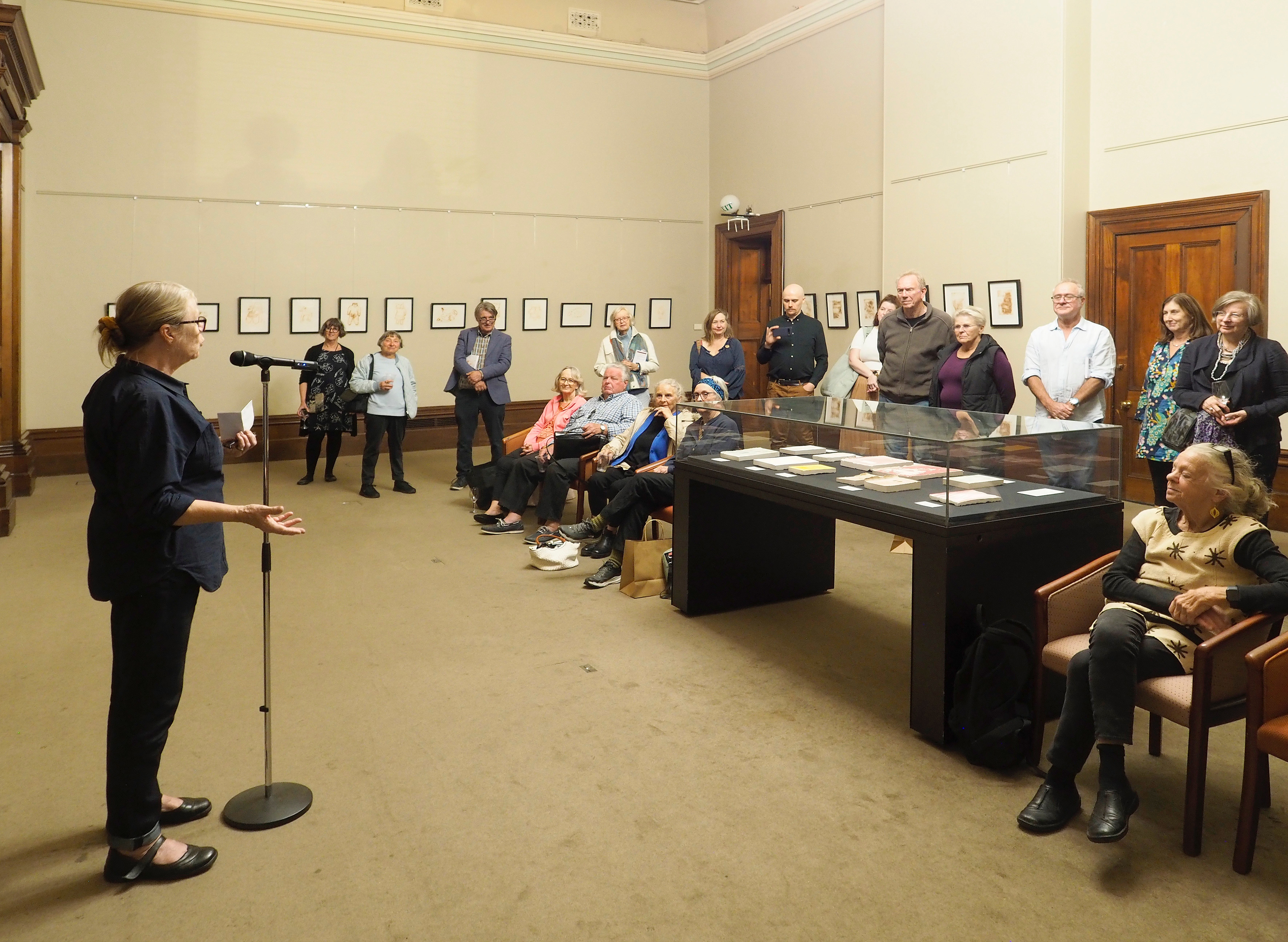
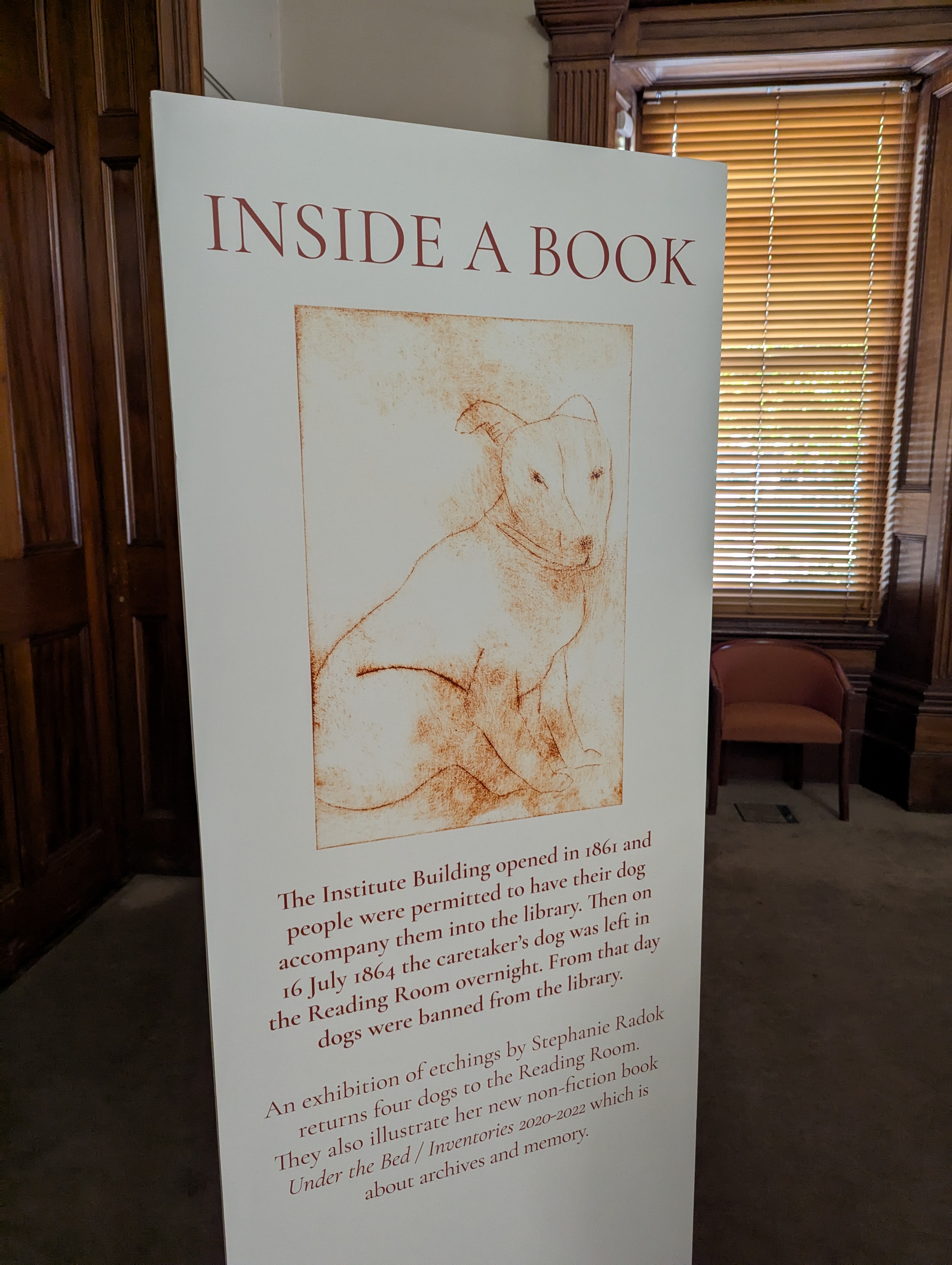
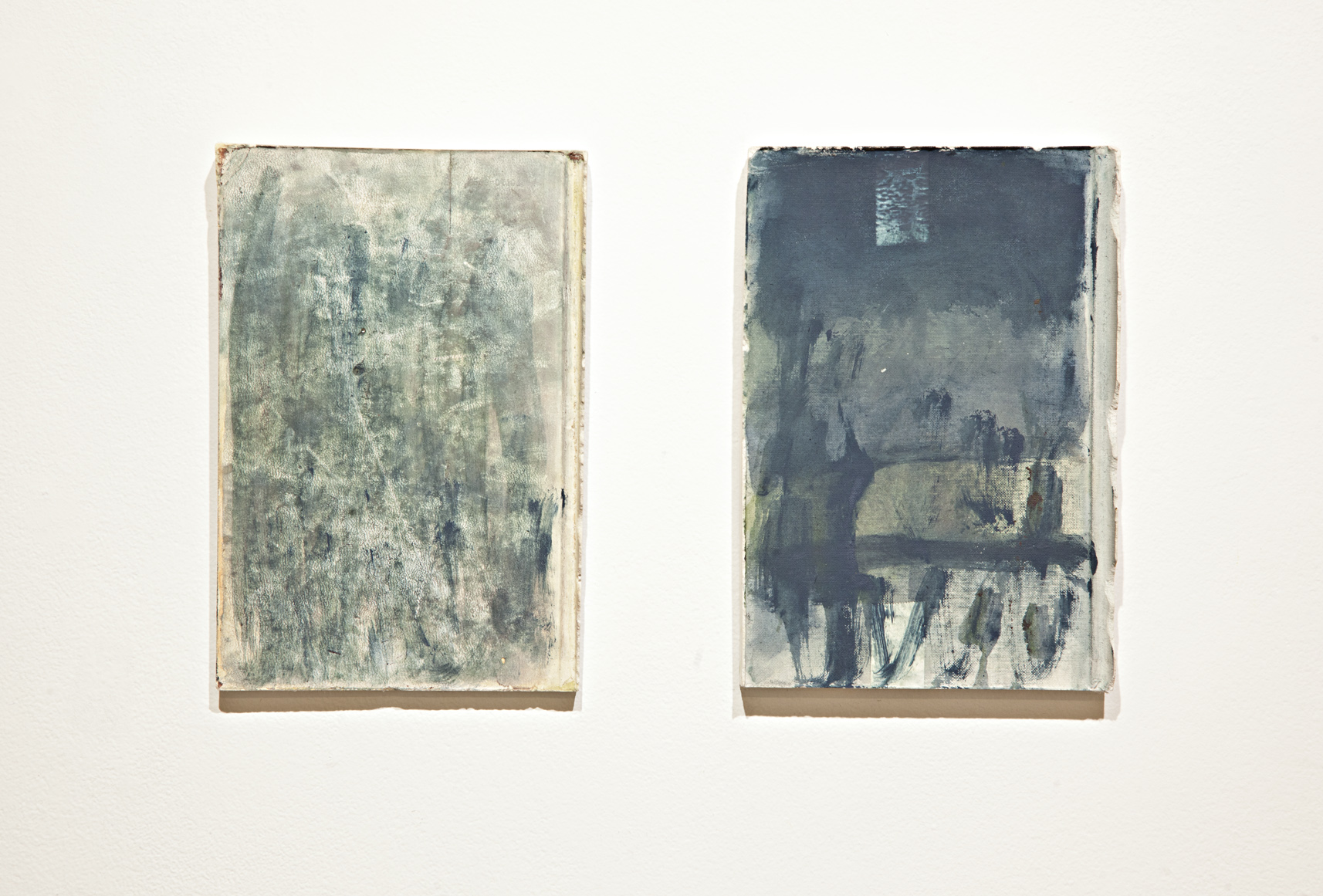
Inside a Book was an exhibition of my etchings and fossil books at the Institute Gallery at the State Library of SA in April 2025. My book Under The Bed / Inventories 2020-2022 was launched in the exhibition by Melinda Rankin, Director of Fabrik, Lobethal.
The connection with the State Library relates to questions of what we do with the past, how do we store it, how do we interpret it, how do we retrieve it. Who are we keeping it for? What can we do with it now?
How can we learn from the past and carry it into the future? How do we come to terms with what we leave behind?
Book launch, 22 April 2025.
I reminded everyone of how this space was the first location of the Art Gallery and Museum of South Australia. Also about Groucho Marx’s joke about it being too dark to read inside a dog.
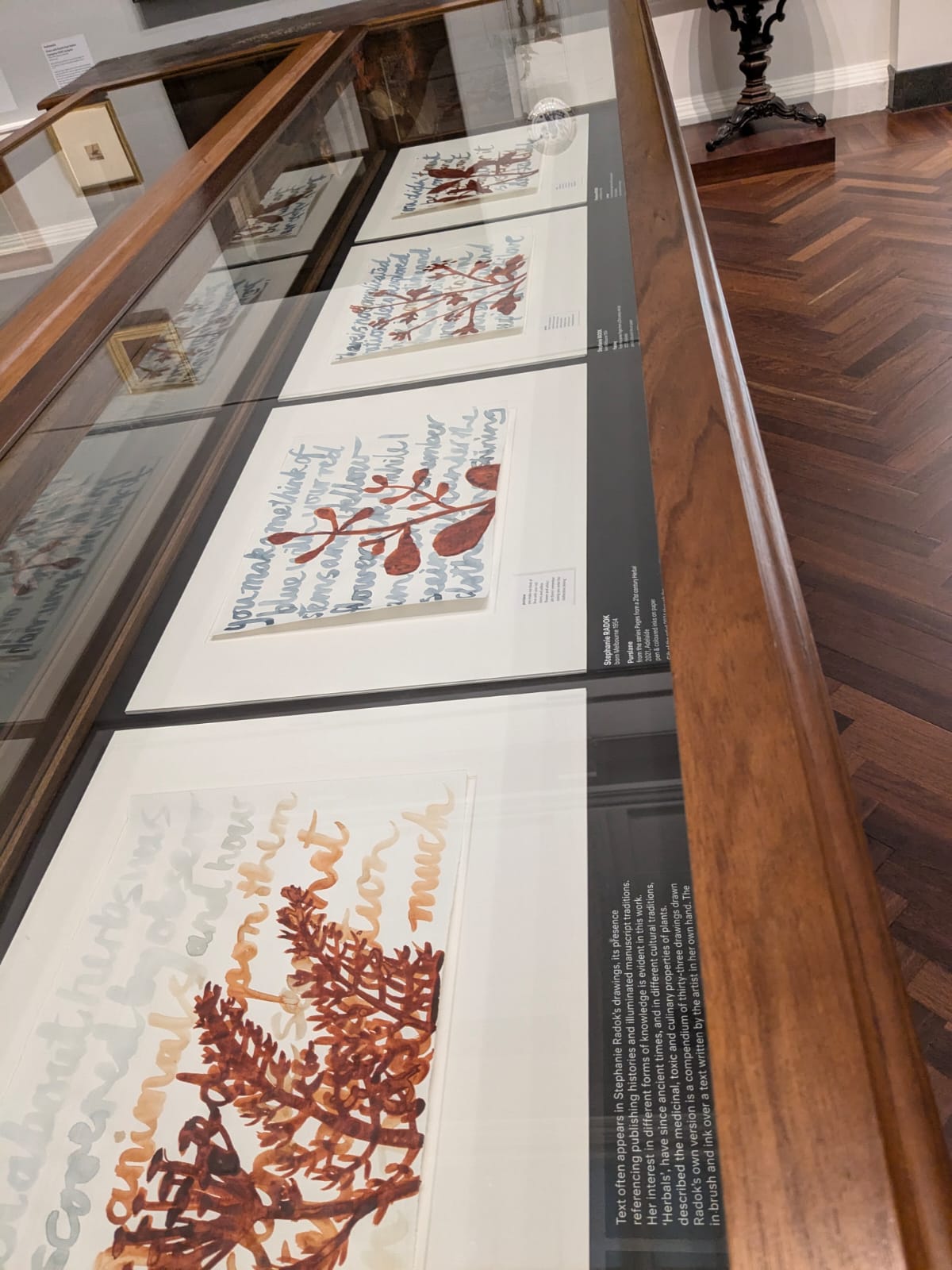
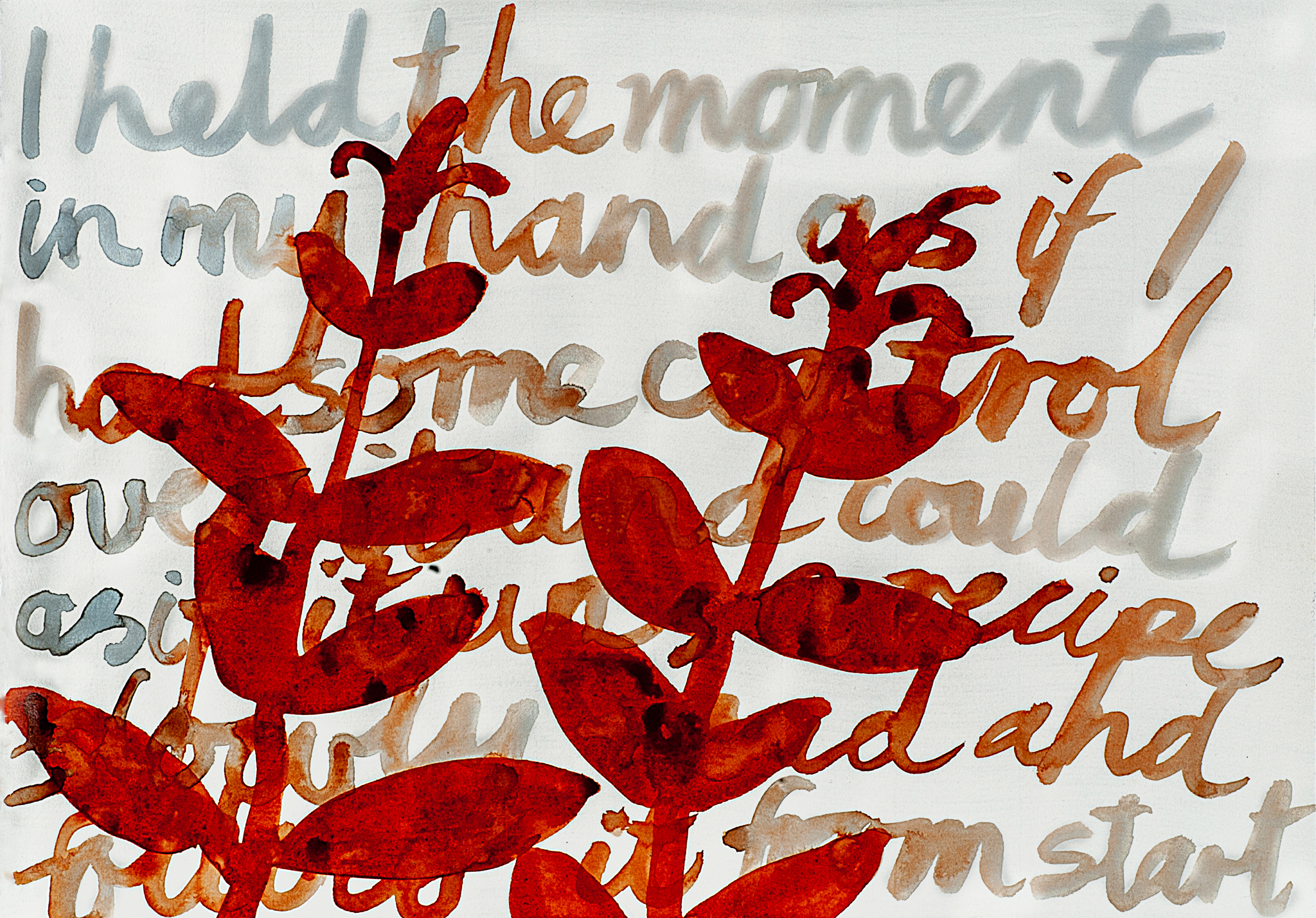
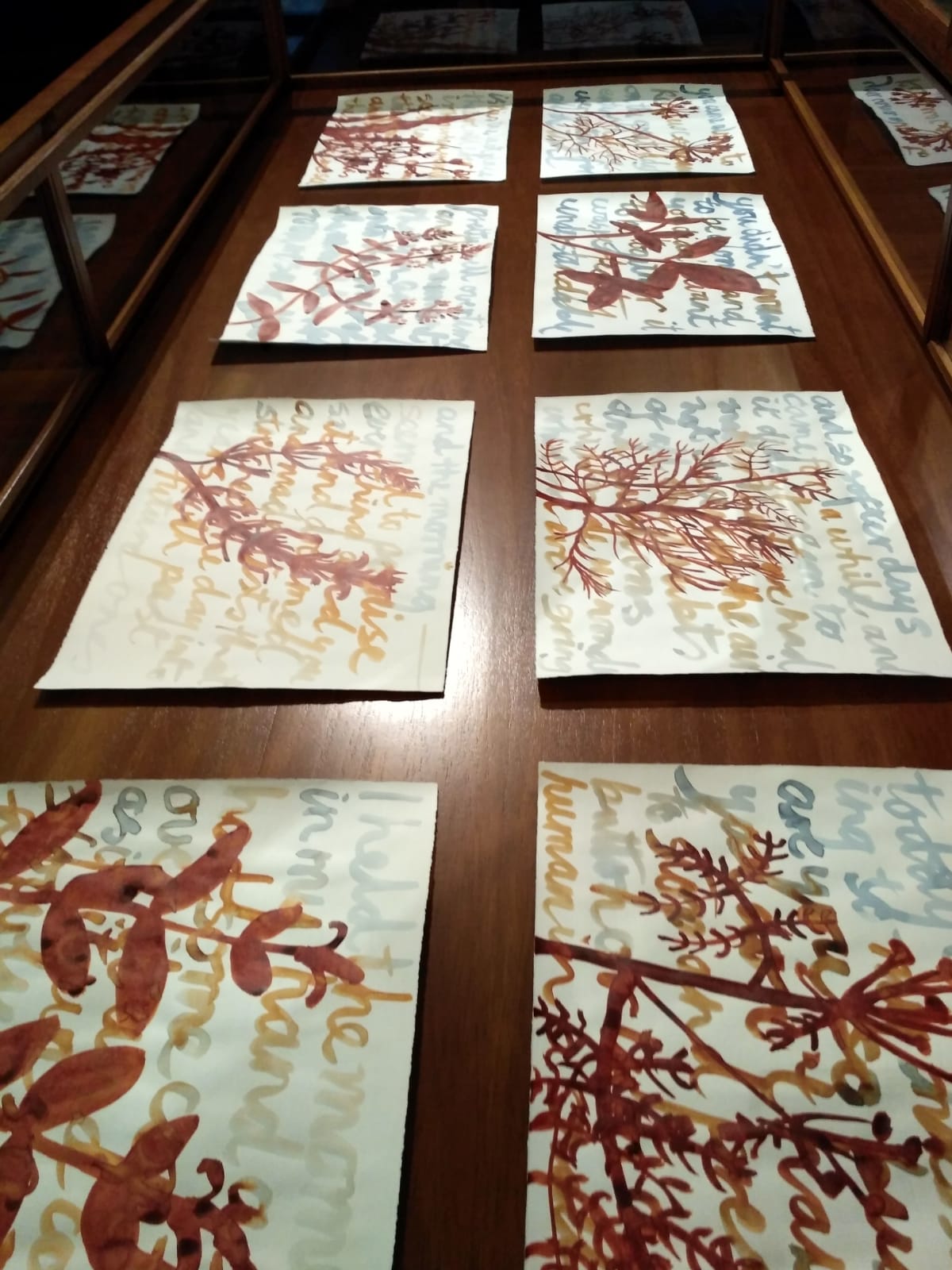
This work was first exhibited at the historic Museum of Economic Botany in the Adelaide Botanic Gardens in 2021. It draws together words and herbs, plants and voices, speaking the unspoken, opening up emotions and thoughts that often remain hidden.
It was acquired by the Art Gallery of South Australia and shown in the first gallery of the Elder wing in 2024-2025.
Stephanie Radok, from Pages from a 21st Century Herbal
Exhibition at the Museum of Economic Botany in the Adelaide Botanic Gardens
Medicinal Plant Tales: everyday stories
an apple a day keeps the doctor away
The use of plants for health and wellbeing is deep rooted in our history. From the earliest times our need for food, fibre and medicine has been based upon the plant world and yet today the link between plants and medicine is often overlooked.
The Santos Museum of Economic Botany, situated at the heart of the Adelaide Botanic Garden, has been amplifying such links and plant stories since 1881. Here one can learn and reflect on the diversity and complexity of cultures and their relationships to plants all over the world.
The Museum is full of tales of colonisation, trade, culture, ingenuity, tradition, innovation, art and curiosity. Among the many plants whose stories are on display are medicinal ones. They possess healing and economic value as well as historic and emotional dimensions.
Contemplating them is a path to remembering your own stories. Most of us have favourite and regular encounters with medicinal plants – Cinchona plants, whose bark is responsible for producing quinine, an antimalarial drug also found in tonic water; or Mentha pipertia (peppermint) that has been used as a digestive for centuries. Then there are the everyday encounters with eucalyptus, turmeric, camomile, aloe vera, echinacea, calendula, ginger, garlic, olive oil, and rosemary.
Australia has its own medicinal plant history. There are First Nations’ traditions and knowledge from centuries of learning and developing the uses of indigenous plants for healing. Then there are the colonisers, settlers, migrants and refugees bringing with them their traditional remedies and plants, and learning how to appreciate local ones.
The artworks in Medicinal Plant Tales focus on the reparative gentle healing properties of medicinal plants and gardens and acknowledges the many stories that link plants, people and health.
Stephanie Radok, installation in Museum in progress
Pages from a 21st Century Herbal artist’s statement
A herbal is a book containing the names and descriptions of plants, specifically their medicinal, culinary and toxic properties. Early herbals from Egypt, India, China and Europe, were handwritten and often accompanied by drawings or paintings.
The first book on herbal medicine that I read was Dorothy Hall’s Herb Tea Book published in 1980. Hall was, in many ways, a pioneer of herbal medicine in Australia. She taught and influenced many of today’s practitioners. Her combination of common sense, humour and knowledge makes her books true manuals for life. They are encouraging, illuminating, practical and down to earth. Her obituary from 2012 states: “The practitioner of the garden and the hedgerows, and the waste lands and the bush was the keeper of the old ways, the old knowledge, the ancient wisdoms, the elder, the sage.”
For Pages from a 21st Century Herbal I looked at images of herbs in various books and painted them in sanguine (blood-red) ink on fine paper. While the ink was still wet I wrote in blue ink directly from my thoughts, a kind of automatic writing, over the plant. The words are not all legible and suggest hidden wisdom and rich silences.
opening talk by Nicholas Jose for my solo exhibition at Prospect Gallery, 2017
I have enjoyed following Stephanie Radok’s work around over the years and it is a pleasure to be doing so again today in this Prospect of Prospects. As always Radok’s work asks us to look up close, as close as we can, at the smallest details of marks and traces, as she attends to things we might otherwise miss, such as the weeds under our feet that are identified here by name, place and quality, if you can bend your head round enough to read the curving writing on the disc: Bathurst Burr troublesome; Red Valerian Glen Osmond Road; Apple of Sodom rear pasture. And equally, as always, her work asks us to look faraway, at the long prospect, experienced as dislocation and then as relationship. Which makes us aware of where we are looking from, or through, our place, a museum vitrine, an artist’s vision, our own perspective. Our prospect.
I have followed Stephanie’s work to a variety of sites—to Murray Bridge for A Covenant with the Animals where her naming of species of strange animals was a joy of making familiar and giving dignity; to the Museum of Economic Botany for something similar with seeds and shapes in Talking about Country ; to Fenn Place, where Adelaide’s Chinatown once was, for a celebration of invisible, ephemeral trade and transport in Out of site; to Melbourne for What we bring with us, where the records became another sort of record, as happens again here, and to Artspace for The Immigrant’s Garden, back in 2002, where materiality became the medium for a remaking of the local in terms of the lost and the mythic. Over this time and in these different places there has been a continuity of concern, but with subtle changes too, a kind of wandering in not quite circles—and here again in this multi-dimensional installation.
What’s new here is the presence, or the memory, of the “beautiful prospects” of others, other artist precursors, who came and looked and made something from their interaction with place under a southern sky. The artist draws on colonial artists whose work has stayed with her, seen in the Art Gallery of South Australia, in Visions of Adelaide 1836-1886 and other exhibitions: Light, Frome, von Guerard, Berkeley. She returns the idea of the sketch, not so much from life as from an inner topography that is at once art historical and personal. So we think of body painting, finger painting, undercoating, painting over. We think of abstraction and calligraphy and desert art. Rothko, Emily Kame Kngwarreye, Lee Ufan. We appreciate the muting of colour. ‘Blue is a darkness weakened by light’, in Goethe’s words, which seem to apply to the new work ‘Home Schooling’.
A constant is the book, and Stephanie is also a writer, as you’ll know from her wonderful work called An Opening: twelve love stories about art, the book of an art writer. In this exhibition we are again presented with the casts of books no longer able to be opened, marked by folds and flaws, but offering a surface, or a vessel, for a further process of feeling and making, overlaying the old pattern of the cover with new decorative colour, and the inset glint of mica from the local hills. These books remember a twelve volume set of Goethe’s works published in Germany in the nineteenth century and brought to Adelaide by the artist’s grandparents in the twentieth: Goethe, the universalist, the man of light, whose wisdom could not avert the unseeingness of progress as it unfolded here too. Under the artist’s hand, those complex ideas and emotions become fragile offerings. Little treasures. ‘Search nothing beyond the phenomena, they themselves are the theory,’ said Goethe. His words release us to enjoy Stephanie Radok’s A Prospect of Prospects. Please take the time. It’s a special occasion, this retroprospective.
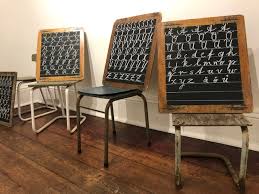
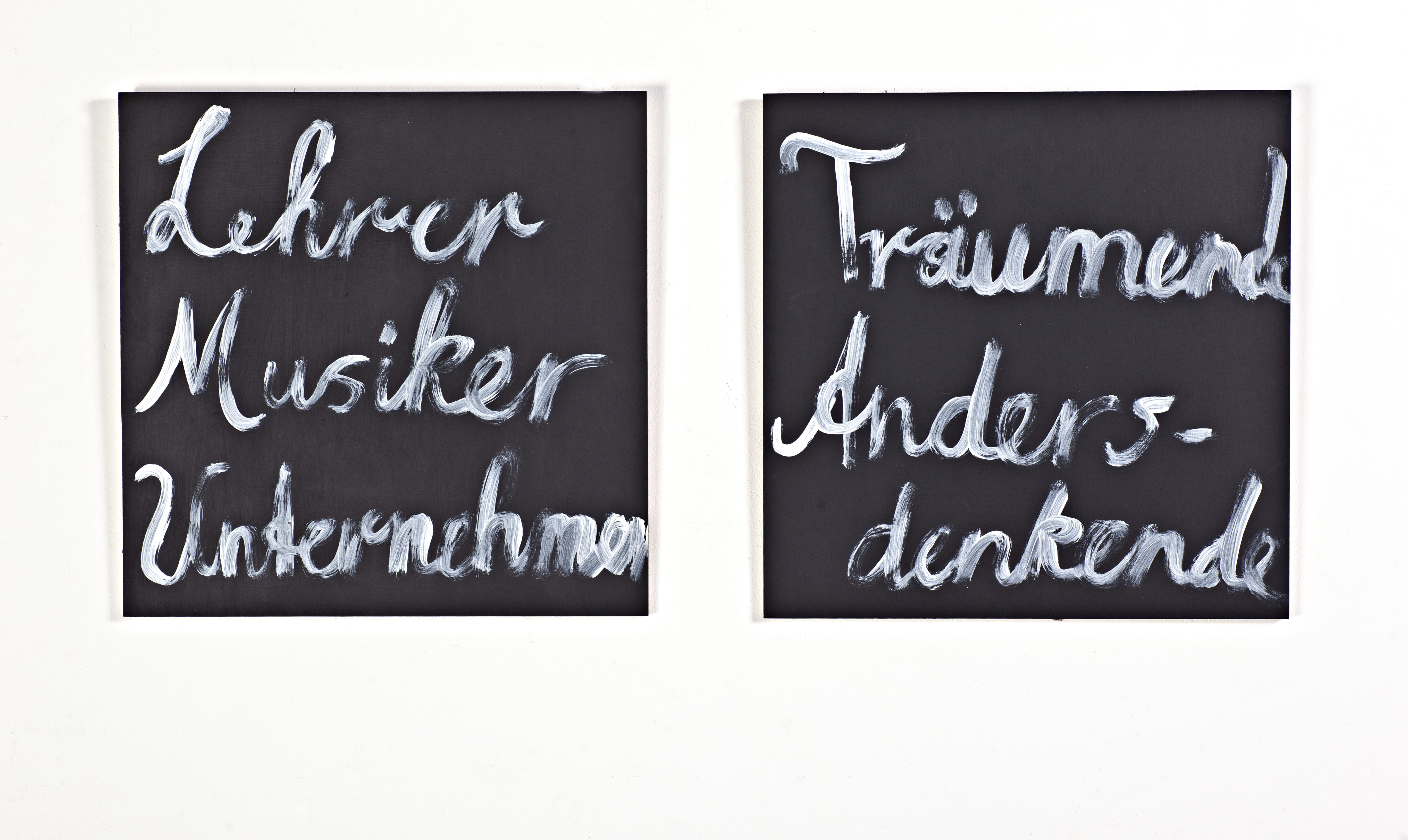
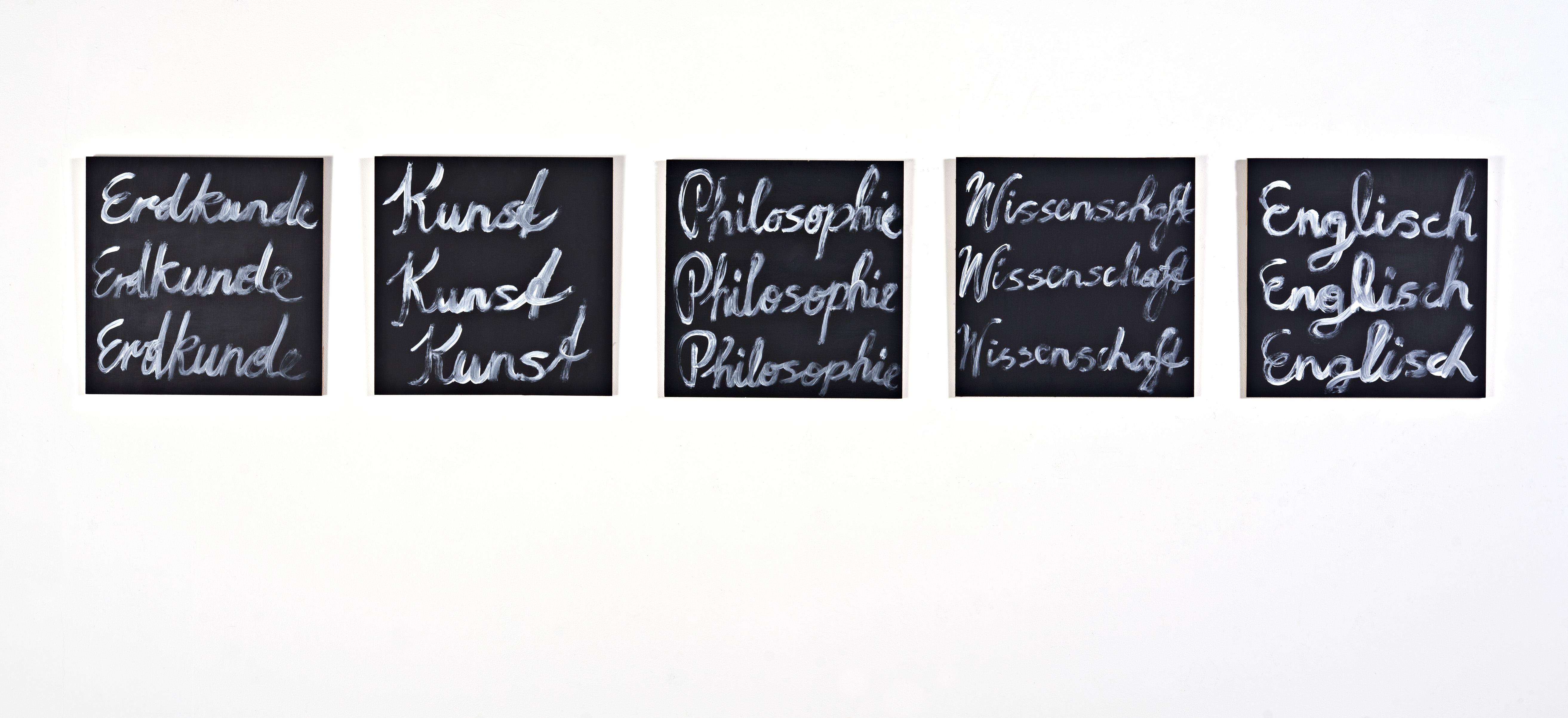
In 2018 at the Hahndorf Academy I was among thirteen artists who made work responding to the history of the building. Local historian Lyndell Davidge showed us through the artefacts and told us stories about the school and hospital that had once been there.
I looked into the story of T.W. ‘Chibby’ Boehm who founded the school in 1857 and taught subjects outside the usual range being taught at the time, such as Geography, Philosophy, Science, Art and History.
I also responded to memories of school in Austria where we learned a fancy script and Australia where it was plain. In both cases handwriting is taught through repetition.

 Stephanie Radok